
DBMS Architecture: 1-Tier, 2-Tier & 3-Tier
 Fiona Marrone
⚡ Riepilogo intelligente
Banca Dati Architecture in DBMS defines how clients, application servers, and database servers are organized to deliver fast, secure data access. This tutorial explains the three core models — 1-Tier, 2-Tier, and 3-Tier — with diagrams, real-world examples, and the criteria that guide architects when picking the right design.
Cos'è Database Architecnologia?
A Banca Dati Architectura is the structural representation of a DBMS design. It guides the design, development, implementation, and maintenance of a database management system. A DBMS architecture divides the database into independent components that can be modified, replaced, or upgraded without disturbing the others, which also helps engineers understand how the parts of a database fit together.
A banca dati stores critical information and provides quick, secure access to it. Selecting the right DBMS architecture is therefore central to efficient data management and to scaling the system as the user base grows.
Tipi di DBMS Architectura
There are three main types of DBMS architecture:
- One-Tier Architecture (Single-Tier Architecnologia)
- A due livelli Architectura
- Tre livelli Architectura
The table below summarizes how the three tiers compare before we examine each one in detail.
| Fila | Livelli | Caso d'uso tipico |
|---|---|---|
| 1-Tier | Client + Server + Database on one machine | Local SQL practice, learning environments |
| 2-Tier | Client (presentation) ↔ Database server | Departmental apps like MS Access contact management |
| 3-Tier | Client ↔ Application server ↔ Database server | Large websites and enterprise systems |
1-Tier Architectura
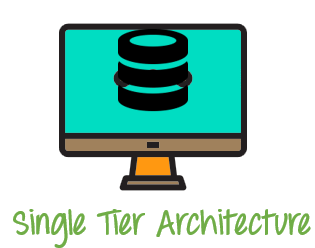
1-Tier Architectura in DBMS is the simplest database architecture, where the client, server, and database all reside on the same machine. A typical 1-Tier example is when you install a database on your own system and run SQL queries against it to practice. This setup is rarely used in production because it has no separation between client and server, no remote access, and no scalability.
2-Tier Architectura
A 2-Tier Architectura in DBMS is a database architecture where the presentation layer runs on a client (PC, mobile, tablet, etc.) and data is stored on a server called the second tier. Two-Tier Architecture provides added security because the database is not exposed directly to the end user, and the direct client-to-server connection delivers faster communication compared to multi-hop designs.

In the 2-Tier client-server architecture above, a single database server is connected to clients 1, 2, and 3, each of which holds its own presentation layer and business logic.
A due livelli Archiesempio di architettura:
A Contact Management System built with Accesso MS is a classic 2-Tier deployment.
3-Tier Architectura
A 3-Tier Architectura in DBMS is the most popular client-server architecture, where the development and maintenance of functional processes, business logic, data access, data storage, and user interface are handled independently as separate modules. The Three-Tier model contains a presentation layer, an application layer, and a database server.
3-Tier database architecture is an extension of the 2-Tier client-server architecture. A 3-Tier architecture has the following layers:
- Presentation layer (your PC, tablet, mobile, etc.)
- Livello applicazione (server)
- Server di database

The application layer sits between the user and the DBMS. It is responsible for relaying user requests to the DBMS and returning responses to the user. The application layer (also called the business logic layer) processes functional logic, constraints, and rules before passing data to the user or down to the DBMS.
Goals of Three-Tier Client-Server Architectura
- Separate user applications from the physical database.
- Support core DBMS characteristics such as concurrency and recovery.
- Achieve program-data independence so schema changes do not break applications.
- Support multiple views of the same underlying data for different user roles.
Tre livelli Archiesempio di architettura:
Almost every large website on the internet — including guru99.com — runs on a 3-Tier architecture.
